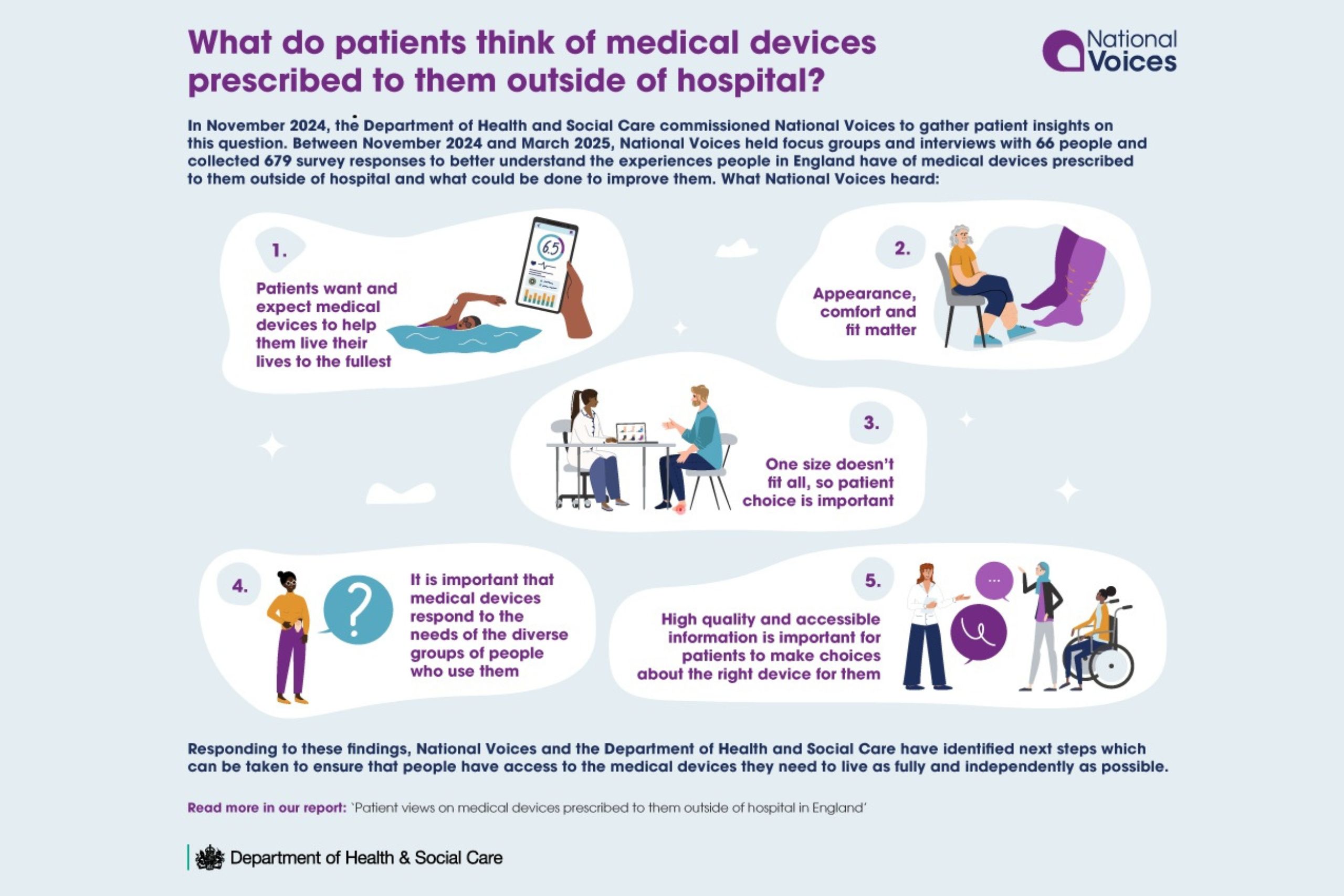
New research commissioned by the Department of Health and Social Care (DHSC) and delivered by National Voices (of which the Urostomy Association is a member) has highlighted the features that matter most to people using urostomy bags prescribed through Part IX of the NHS Drug Tariff* – and where improvements are needed.
The study forms part of a wider project exploring patient experience of the 60,000 medical devices available under Part IX. Between November 2024 and March 2025, National Voices gathered nearly 700 survey responses and conducted in-depth interviews and focus groups, including 99 responses specifically from people using urostomy products. The project aimed to understand the features patients value most, so these insights can inform future categorisation and assessment of devices.
The findings reinforce what the Urostomy Association hears regularly from its members: urostomy devices are not just medical products – they are essential to people’s independence, dignity, confidence and quality of life.
What urostomy patients value most
People living with a urostomy consistently identified several features as essential to a good-quality device:
- Effective skin protection and comfort, including base plates that do not irritate the skin and maintain adhesion
- Leak prevention, with secure adhesion and convex designs proving vital for many people
- Ease of use, including pre-cut pouches, clear visibility during application and simple, accessible taps – particularly important for people with reduced dexterity or sight loss
- Compatibility with night drainage systems, including secure connections and appropriate tubing lengths for both daytime and overnight use
- Durability, with base plates that remain secure even when bags are full and do not break down prematurely
These features directly affect whether people feel confident leaving the house, sleeping well, exercising, or participating fully in daily life.
People living with a urostomy consistently identified several features as essential to a good-quality device:
- Effective skin protection and comfort, including base plates that do not irritate the skin and maintain adhesion
- Leak prevention, with secure adhesion and convex designs proving vital for many people
- Ease of use, including pre-cut pouches, clear visibility during application and simple, accessible taps – particularly important for people with reduced dexterity or sight loss
- Compatibility with night drainage systems, including secure connections and appropriate tubing lengths for both daytime and overnight use
- Durability, with base plates that remain secure even when bags are full and do not break down prematurely
These features directly affect whether people feel confident leaving the house, sleeping well, exercising, or participating fully in daily life.
Ongoing challenges and impact on wellbeing
Despite the range of products available, many participants described persistent problems, including:
- Adhesives failing due to heat, sweat or poor-quality base plates, leading to distressing leaks at home and in public
- Base plates breaking down
- Limited flexibility and poor design of flanges, taps and pouches, making products harder to apply or manage
- Incompatibility between devices from different manufacturers
- Visible bulging, twisting of pouches and lack of clips to prevent movement
For many, these issues caused anxiety, loss of confidence and significant impacts on mental wellbeing – particularly when leaks occurred outside the home.
Participants also raised concerns about the environmental impact of urostomy products and a desire for more sustainable options where clinically appropriate.
Choice, information and inequalities
A recurring theme throughout the research was a lack of awareness that patients often have choices about the urostomy products they use. Some people believed there was only one type of pouch available to them – the one they were issued following their surgery.
The report also highlights the importance of device design that reflects the needs of diverse groups, including people from ethnically diverse communities, those with disabilities, and people with limited dexterity or sensory impairments. Colour options, accessibility of packaging, and ease of handling all play a role in whether a device works in real life.
DHSC next steps
In response to the findings, the DHSC has committed to a series of actions that are highly relevant to urostomy patients, including:
- Ensuring that a wide range of device choices continues to be available through Part IX of the NHS Drug Tariff
- Improving information for patients about available devices and how prescribing decisions are made
- Conducting further work with local decision-makers to reduce unwarranted regional variation in access to devices
- Strengthening patient involvement in decision-making by embedding patient voice within the Part IX Independent Assessment Panels
- Introducing a “value add” component to the Quality Evaluation Framework to incentivise manufacturers to address health inequalities through device design
Recommendations to manufacturers and local decision-makers
The report also sets out clear expectations for those responsible for designing and selecting urostomy devices:
Manufacturers are encouraged to:
- Design and redesign products based on what matters most to users, including comfort, fit, discretion, wearability and independence
- Work directly with people who use urostomy devices – including those experiencing inequalities – to co-design improvements
- Test products with people who have limited dexterity or sight loss to ensure accessibility
Integrated Care Boards (ICBs) and others deciding which devices are made available locally are urged to:
- Consider the social, emotional and practical impact of devices, not just clinical function
- Ensure prescribing decisions comply with the Equality Act 2010 and the Public Sector Equality Duty
- Make sure patients are informed of their choices and supported to access peer support
- Factor aesthetics and patient preference into decision-making, rather than limiting options unnecessarily
Commenting on the findings, Samantha Sherratt, the Urostomy Association’s Transformation Director, said:
“This excellent research carried out by National Voices validates what people with urostomies have been telling us for some time: the right device can be life-changing, and the wrong one can be devastating. Choice, quality and good information are not ‘extras’ – they are essential. We welcome the DHSC’s commitment to embedding patient voice and tackling inequalities, and we will continue to work with partners, like National Voices, to ensure urostomy patients are heard, respected and supported.”
*Part IX of the NHS Drug Tariff sets out which medical devices, including urostomy products, can be prescribed on the NHS and supplied to patients in England.